Hiện tượng loe mép mũi khoan côn: Tại sao xảy ra và cách phòng tránh
A tapered drill bit can fail without losing its carbide first.
The cutting edge may still look usable. The insert may not be badly worn. Yet the rear skirt around the taper hole has expanded, distorted, or cracked. The bit no longer seats correctly on the drill steel. It begins to loosen, run off-center, or becomes difficult to remove.
This failure is often called skirt flaring.
It is a frustrating problem because it can make a bit unusable before normal carbide wear has ended its service life. It also affects more than the bit. A flared taper hole can damage the drill-steel shank, reduce energy transfer, worsen hole accuracy, and create downtime during a shift.
The solution is not one material change or one operating adjustment. Skirt flaring usually results from a combination of bit selection, geometry, steel quality, manufacturing control, taper fit, and field practice.
What is skirt flaring in a tapered drill bit?
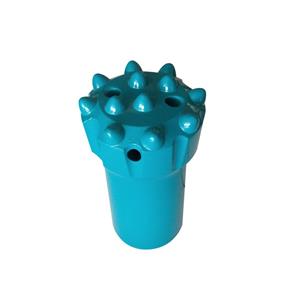
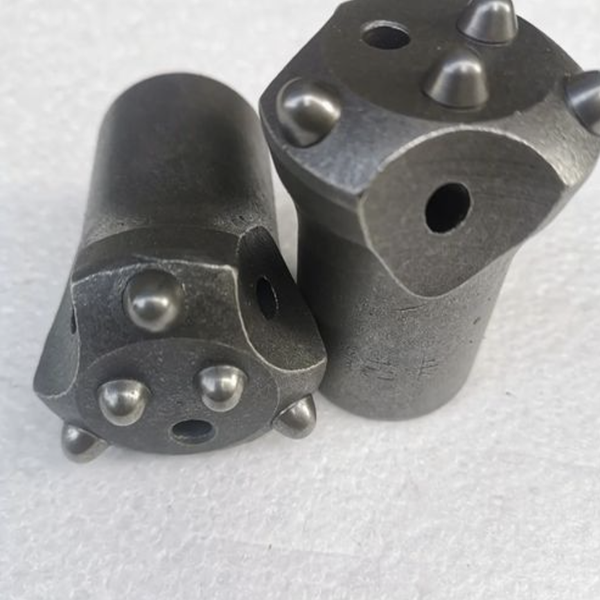
A tapered drill bit connects to the drill steel through a tapered hole. During drilling, impact energy travels from the rock drill through the steel and into the bit. The taper connection must stay tight enough to transfer energy efficiently while allowing the bit to be removed when needed.
Skirt flaring happens when the bit body around the taper hole expands or deforms under repeated impact. The rear opening of the bit can become oversized, sometimes with visible cracking or a loss of the original shape.
Once the fit is compromised, the connection is no longer stable. The bit may rock on the taper, absorb energy inefficiently, or create concentrated loads on the drill steel and bit body.
In severe cases, the problem accelerates quickly. A loose connection produces more impact concentration, which creates more deformation, which makes the connection even looser.
The first cause: a bit that does not match the job
A tapered drill bit must be selected for the rock, the drill, the hole diameter, and the operating conditions.
The same bit design may work well in medium-hard granite and fail rapidly in a much harder, tougher, or more abrasive formation. A light-duty bit body may not have enough strength around the taper hole for heavy impact conditions. A bit with an unsuitable face design may drill inefficiently, creating more heat and stress in the body.
This is why one universal tapered bit is rarely the best answer.
A proper product range should include different designs for different rock conditions and drilling equipment. Chisel, cross, horseshoe, and button-bit profiles may all have a place. The correct choice depends on the formation and the working load, not simply on what is available in the storeroom.
If the same bit type repeatedly shows skirt flaring in one mine or tunnel, the first question should be whether the bit is properly matched to that application.
Geometry around the taper hole matters
The taper-hole area is a structural connection, not an empty space drilled into the bit body.
Wall thickness, taper angle, insertion depth, bottom geometry, transition radii, and contact area all influence how the bit absorbs impact. Sharp internal transitions or uneven wall thickness can concentrate stress. Insufficient contact between the drill-steel taper and the bit hole can create localized loading. A poor fit can turn the connection into a hammering point instead of an energy-transfer point.
A well-designed tapered connection should support several goals:
Stable and centered seating on the drill steel
Sufficient contact area for impact transfer
Adequate bit-body thickness around the taper hole
Smooth transitions that reduce stress concentration
Reliable self-locking without excessive force during installation
Practical removal after drilling
The connection must be strong, but it should not depend on brute force. Striking a bit onto a taper too aggressively can damage the fit before drilling even begins.
Bit-body steel and heat treatment are critical
A tapered bit skirt works under repeated shock loading. It needs enough strength to resist plastic deformation and enough toughness to avoid brittle cracking.
If the bit-body steel is too soft, the taper hole may expand under impact. If it is too hard or poorly heat-treated, the area may crack instead. The correct result is a balance: stable geometry with sufficient resistance to fatigue and impact.
That balance depends on the steel grade, forging quality, machining accuracy, heat-treatment cycle, and cooling control. Material quality cannot be judged from appearance alone.
The bit may look identical to another product while having very different performance because of differences in steel cleanliness, grain structure, hardness distribution, or heat-treatment consistency.
For demanding applications, suppliers should be able to explain how they control bit-body material and how the product is matched to its intended rock conditions.
Taper fit and drill-steel condition cannot be ignored
A good bit on a worn drill steel can still fail early.
The taper shank must have the correct angle, surface condition, and dimensions. A damaged, undersized, oversized, or poorly finished taper can prevent full seating. The result is uneven contact and concentrated impact on a small area of the skirt.
Before fitting a new bit, inspect the drill-steel taper for:
Visible wear or flattening
Cracks or surface damage
Corrosion and built-up debris
Incorrect taper angle
Poor concentricity
Evidence of overheating or abnormal contact marks
The taper hole inside the bit should also be clean. Dirt, chips, scale, or residue can prevent correct seating and create a false fit.
A tapered connection is only as good as both halves of the connection.
Installation and removal practice affect tool life
Field handling makes a measurable difference.
Mũi khoan cần được lắp đặt chắc chắn nhưng không được lạm dụng trong quá trình lắp đặt. Việc dùng búa đập quá mạnh có thể làm biến dạng phần chân mũi khoan hoặc làm hỏng các bề mặt côn. Trong quá trình vận hành, đội ngũ công nhân cần chú ý đến các hiện tượng như rung động bất thường, giảm khả năng xuyên thấu, rò rỉ nước hoặc các dấu hiệu cho thấy mũi khoan không hoạt động đúng hướng.
Việc loại bỏ cũng cần được chăm sóc cẩn thận như vậy.
Các phương pháp tự chế như dùng lực mạnh không kiểm soát có thể làm hỏng lỗ côn, thân mũi khoan hoặc thép khoan. Dụng cụ tháo mũi khoan chuyên dụng và thước đo kiểm tra thường xuyên giúp bảo vệ các bộ phận và làm cho quy trình lặp lại dễ dàng hơn.
Việc mài lại cũng rất quan trọng. Nếu mũi khoan được sử dụng đến khi cạnh cacbua bị cùn quá mức, tải trọng khoan sẽ tăng lên. Mũi khoan có thể tạo ra nhiều nhiệt hơn và truyền nhiều ứng suất gây hại hơn vào thân máy. Việc mài lại kịp thời giúp duy trì cả hiệu suất xuyên thấu và tuổi thọ cấu trúc.
Danh sách kiểm tra phòng ngừa thực tế
Nếu mũi khoan côn có hiện tượng loe phần chân mũi liên tục, hãy kiểm tra toàn bộ hệ thống thay vì thay thế từng mũi một.
Hãy đảm bảo rằng thiết kế mũi khoan phù hợp với độ cứng của đá và thiết bị khoan.
Kiểm tra độ côn và độ chính xác kích thước của mũi khoan thép.
Kiểm tra các lỗ côn để đảm bảo chúng khớp đúng vị trí và có dấu tiếp xúc.
Kiểm tra lại tính nhất quán về vật liệu thân mũi khoan và quá trình xử lý nhiệt với nhà cung cấp.
Tránh các phương pháp lắp đặt cưỡng bức và tháo dỡ không kiểm soát.
Bảo dưỡng các dụng cụ tháo mũi khoan và thước đo độ côn.
Mài lại các cạnh cacbua trước khi độ mài mòn quá mức làm tăng ứng suất khi khoan.
Ghi lại vị trí và thời điểm xảy ra sự cố để xác định các mô hình đặc trưng của từng tầng địa chất.
Thông tin này biến một lỗi lặp đi lặp lại thành một vấn đề kỹ thuật có thể giải quyết được.
Mục tiêu là hao mòn bình thường, chứ không phải biến dạng sớm.
Một mũi khoan côn tốt nên được thay thế khi lưỡi cắt đã hoàn thành công việc hữu ích, chứ không phải vì lỗ côn bị biến dạng sớm.
Khi thiết kế, vật liệu, độ khít và cách sử dụng mũi khoan được kiểm soát đồng bộ, hiện tượng loe mép mũi khoan sẽ giảm đi đáng kể. Chuỗi khoan sẽ giữ được độ căng tốt hơn, năng lượng va đập được truyền tải hiệu quả hơn, và đội ngũ vận hành có thể dự đoán được tuổi thọ của cả mũi khoan và thép khoan.
Đó mới là mục tiêu thực sự: tạo ra một kết nối ổn định cho phép cacbua thực hiện việc cắt và cho phép mũi khoan mòn một cách bình thường.